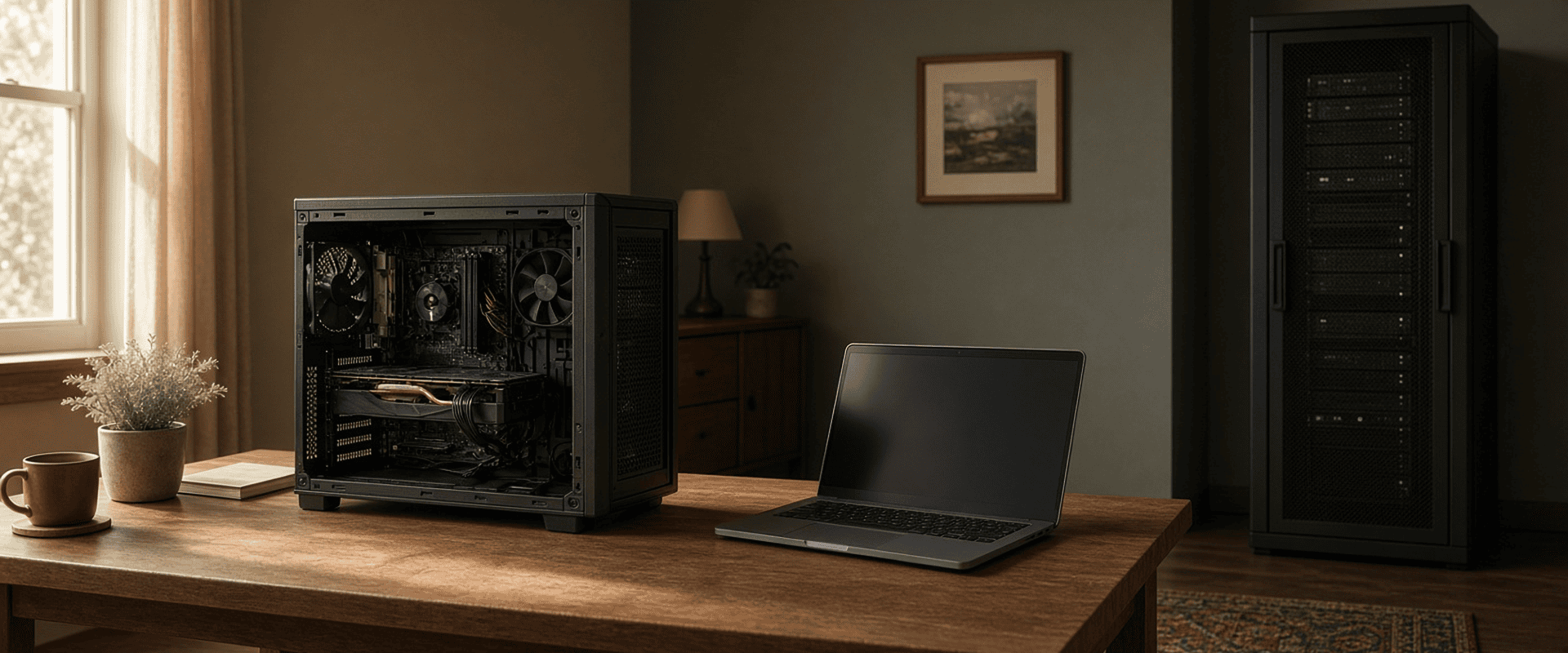
Fully local AI agents run entirely on your own hardware — no API keys, no per-token billing, and no data leaving your machine. Open-source projects prove it is viable: an autonomous agent that browses the web, writes code, and plans tasks using models served locally through Ollama or LM Studio. But local is not automatically better, and here is what we learned evaluating it for real software work.
What is a fully local AI agent?
A fully local AI agent is an autonomous system that runs its language model, tools, and memory on hardware you control, instead of calling a cloud API. It routes each request to a specialised capability — web browsing, code generation, file handling, or planning — and executes multi-step tasks without a subscription. The model itself is an open-weight option like Qwen or Gemma, served through a local runtime such as Ollama, LM Studio, or a llama.cpp-compatible server. Conversation state persists between sessions, and many designs keep a cloud provider as an optional fallback for the hardest requests. The pitch is simple: capable autonomy for the cost of electricity, with your code and prompts never touching someone else’s servers.
The real appeal: privacy and predictable cost
Two things make local agents genuinely attractive. First, privacy: when the model runs on your own box, proprietary code, customer data, and internal prompts stay in-house by construction. That matters for regulated industries and for teams who simply do not want their source flowing through a third party. Second, cost predictability: there is no meter running per token. Once the hardware is paid for, an overnight batch of refactors costs the same as a single query. For hobbyists and privacy-first teams, that combination is compelling, and it explains why these projects rack up tens of thousands of stars.
When we first tried a local setup, the appeal was obvious within minutes — watching an agent reason through a task with no network calls feels different, in a good way.
Where local models still fall short for real dev work
Honesty matters here. The models that fit on a typical developer machine — roughly 14 to 32 billion parameters — are strong, but they are not frontier models. For everyday scripting and well-scoped changes they hold up. For complex, multi-file software work where a single wrong assumption cascades into broken tests, the quality gap against the best cloud models is still real. Hardware is the other wall: code-capable models want careful quantisation and substantial VRAM, and a daily-driver laptop caps out faster than the marketing suggests. You can run a capable coder or a capable reasoner, but often not both at full size at once.
- Quality ceiling: local 30B-class models trail frontier models on hard, long-horizon coding.
- Hardware limits: code-safe quantisation plus long context quickly exhausts consumer memory.
- Ops burden: you now own model updates, serving uptime, and the fallback logic.
How we think about local versus cloud on our platform
On our AI development platform, we evaluated the fully-local approach carefully and deliberately kept a frontier model as the primary engine, with local models treated as a quality-gated option rather than a default. The reason is our order of priorities: output quality comes first, and cost second. When your platform already runs on a flat subscription rather than per-token billing, the headline savings of going local shrink toward zero, which removes the strongest argument for putting a smaller model on the critical path. So we invert the usual framing: the best available model stays primary, and a local model has to prove, on a real evaluation, that it matches quality before it earns any traffic.
That is not anti-local. It is a sequencing decision — adopt local where it demonstrably holds quality, and never trade the reliability of generated code for a saving you do not need.
When should you choose a local AI agent?
Choose local when privacy is non-negotiable, when you work offline or air-gapped, or when you are experimenting and cost sensitivity outweighs the last few points of quality. A local agent is a fantastic fit for personal automation, private research, and internal tooling where “good” beats “perfect.” Choose cloud when you are shipping production software whose correctness a client depends on, where the strongest model earns its keep on the tasks that are hardest to get right. Many teams land on a hybrid: local by default for routine work, with an automatic fall-through to a frontier model when confidence drops. That pattern gives you privacy and predictability most of the time, and quality exactly when it counts.
Frequently asked questions
Do local AI agents need an internet connection?
No. Once the open-weight model and runtime are installed, a local agent can plan, code, and use local tools completely offline. Internet is only needed if you enable web browsing or configure a cloud model as an optional fallback for difficult requests.
Are local AI agents cheaper than cloud APIs?
They can be, but it depends. After the hardware cost, there is no per-token charge, which suits heavy or repeated workloads. If you already pay a flat subscription for a cloud model, though, the marginal savings are small and rarely justify a drop in output quality.
Can local models handle complex software projects?
Partly. Models in the 14–32B range handle scoped changes and routine coding well. For large, multi-file work where mistakes cascade, frontier cloud models still lead. A hybrid setup that escalates hard tasks is the most reliable approach today.
What hardware do I need to run a local AI agent?
For a capable coding model at safe quantisation, plan for a machine with substantial GPU memory — roughly 24GB or more for smooth work at longer context. Smaller models run on less, but quality drops, so match the model size to the seriousness of the task.
If you are weighing local versus cloud for a real product, our team at NxtFruit can help you design an AI development approach that puts quality first — get in touch to talk it through.
Get a free recommendation from a senior engineer.